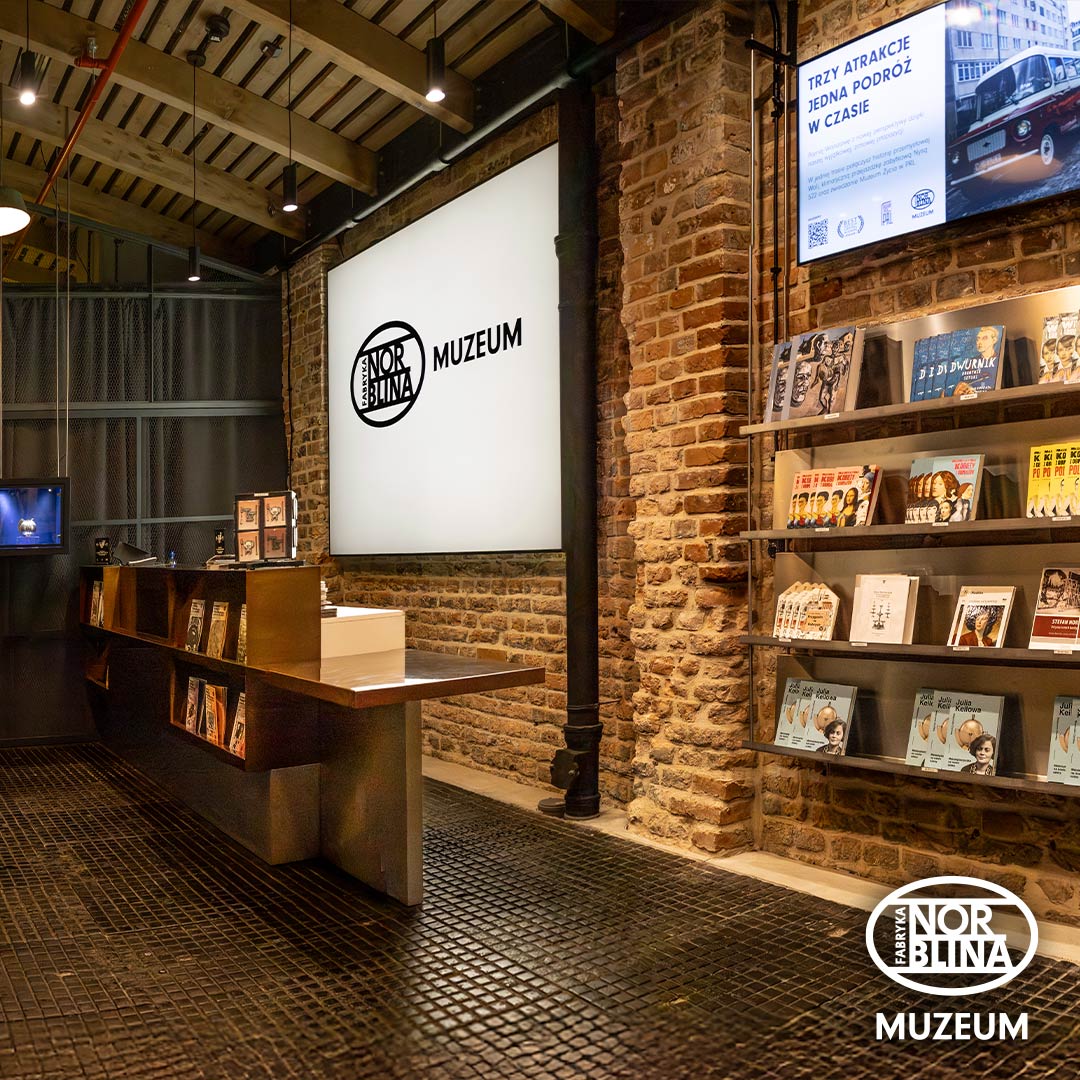
A new version of the Tickets/Info point at the Norblin Factory Museum has been created within just 25 square metres. The project was designed by Jakub Szczęsny, an architect known for works aimed at improving the surrounding reality, including the iconic Keret House in Warsaw’s Wola district. Located in the historic Namiarownia building, the new arrangement combines informational, ticketing and museum functions, while also serving as a symbolic gateway to discovering the history of the former factory.
The Tickets/Info point is the first-place visitors encounter when entering the Norblin Factory Museum. This is where tickets are purchased, guides collected, visiting routes explained and key themes of the history of the factory at Żelazna Street introduced. The redesigned space offers a clear and accessible introduction to the story of Norblin Factory, preparing visitors for further exploration of the entire complex. In this sense, it functions as a distinctive entrance to the museum’s permanent exhibition.
The new Tickets/Info point was designed by Jakub Szczęsny, in collaboration with Karolina Potębska. Szczęsny is widely recognised for projects such as the Keret House, one of the most distinctive architectural works created in Poland in recent decades. His practice focuses on precise, functional interventions in challenging, often highly constrained spaces. At Norblin Factory, the key challenge was to combine several functions—informational, educational and retail – within a compact area of just 25 square metres.
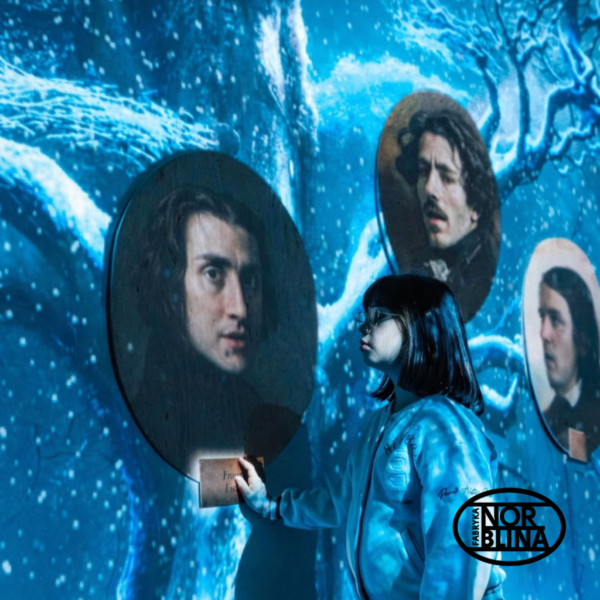
The central element of the interior is a long, horizontal counter, designed to accommodate a variety of visitor needs while intuitively guiding them further into the museum experience. The structure of the counter ensures accessibility for people with disabilities, enables efficient visitor service, distribution of audio guides and the simultaneous work of two staff members. The entire installation functions like a contemporary “console interface” for the museum. The backdrop for the new design consists of original brick walls, historic industrial lighting and cast-iron floor plates, preserved from the factory’s operational period and carefully restored. Another important feature of the space is a miniature photoplasticon, which serves as a visual introduction to the story of Norblin Factory and a prelude to the subsequent stages of the museum visit.
The space also features a display case presenting a reproduction of the iconic spherical sugar bowl designed by Julia Keilowa – the most valuable object available in the museum shop. The light, almost jewellery-like form of the display case was designed as an integral part of the interior arrangement, highlighting the significance of an object that is still regarded as an icon of Polish Art Deco. The original sugar bowl was created around 1935 on commission from the Norblin, Bracia Buch and T. Werner factories. The Norblin Factory Museum has produced a limited series of faithful reproductions, using historical technologies and traditional metalworking techniques. The reconstruction was carried out by Tomasz Gil, who recreated the processes of forming, construction and silver plating; work on the project took more than two years. This display is complemented by simple, elegant shelves presenting other items from the museum shop—souvenirs inspired by the history of Norblin Factory. The entire composition aligns with the minimalist character of the project, combining retail function with museum narrative and the aesthetics of the site.
You are warmly invited to visit.